
What makes someone brilliant?
I’ve spent years sitting across from people, some in therapy rooms, some in documentary interviews, asking them about their lives. And one question always bubbles up: Why do some minds seem to sparkle while others simply… function?
Here’s what I’ve noticed. We throw the word “intelligent” around like confetti. We call singers intelligent. Footballers intelligent. Even horses running “intelligent races”. But if everything is intelligence, then nothing really is.
And then there’s creativity, that mysterious cousin we can’t quite define. We know it when we see it. But where does it come from? And here’s the question that keeps psychologists up at night: Are smart people creative? Or are creative people smart?
Over the next few minutes, I’m going to take you inside the fascinating, sometimes weird, world of intelligence research. We’ll look at Einstein’s brain, explore whether IQ tests actually measure anything real and uncover the surprising relationship between intelligence and creativity.
By the end, you’ll never look at “smart” the same way again.
Quick disclaimer: I’m Maryam, a digital journalist with a psychology and counselling background. Everything I share comes from my research, my nerdy fascination with how people work and my psychology degree. This is my interpretive lens, not a textbook, not sponsored by anyone, just me trying to make sense of the beautiful mess that is the human mind.
Table of Contents
What Are We Actually Measuring When We Talk About Intelligence?
Close your eyes for a second. Picture an intelligent person.
What did you see?
Was it Einstein with his wild hair? A kid solving math problems faster than you can type them into a calculator? Someone who just gets people, who knows exactly what to say when you’re upset?
Here’s the thing: everyone sees something different. And that’s exactly the problem psychologists have been wrestling with for over a century.
In 2018, researchers Neubauer and Martskvishvili tried to pin this down. They looked at intelligence through the lens of Maslow’s Hierarchy of Needs. But here’s what’s fascinating: they found that how we define intelligence actually shapes what we find when we study it.
Some researchers say intelligence is about adapting to your environment. Others say it’s about learning quickly. Still others insist it’s about reasoning, planning, solving problems, thinking abstractly, the list goes on.
And then there’s the testing movement definition: “Intelligence refers to the ability to reason deductively or inductively, think abstractly, use analogies, synthesise information and apply it to new domains”. Or as Holt, Bremner and Sutherland put it in 2019, “Intelligence is the ability to acquire knowledge, to think and reason effectively and to deal adaptively with the environment“.
So here’s my psychological takeaway after digging through all this: Intelligence isn’t one thing, it’s a family of things wearing the same name.
Think of it like music. We use one word, music, but we’re talking about everything from Beethoven to Beyoncé to birds singing at dawn. Intelligence is the same. It shows up differently depending on who you are, where you are and what life is asking of you.
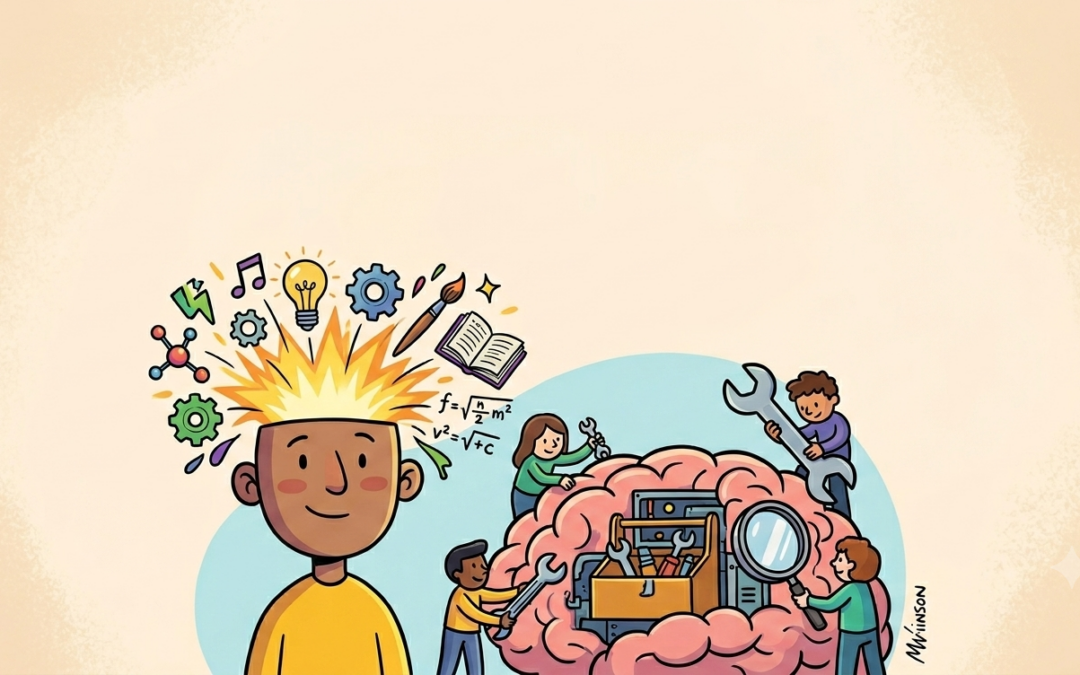
And that’s actually comforting. Because it means intelligence isn’t this fixed thing you either have or don’t have. It’s more like a toolkit and we all carry different tools.
A Quick Trip Through History: Nature vs. Nurture
I want to tell you a story about a dead physicist’s brain.
When Albert Einstein died in 1955, the pathologist who performed his autopsy, a man named Thomas Harvey, did something that would follow him for the rest of his life. He took Einstein’s brain. Without permission. And kept it in jars for decades.
Why? Because he wanted to find out what made Einstein a genius.
Here’s what they found when they finally studied it properly: Einstein’s brain was… unremarkable.
Weight? Average. Length? Average. Width? Average. For a man his age, everything fell right in the normal range.
I love this. Because it perfectly captures the oldest debate in psychology: is intelligence something you’re born with or something you develop?
Socrates, way back in 400 BC, thought intelligence was innate; you’re just born with it. Descartes, in the 1600s, said it was God-given. Then John Locke comes along and says, “Nope, the mind is a blank slate, everything comes from experience.” Kant tried to split the difference, suggesting our minds are pre-wired to perceive the world in certain ways.
Then came the testing movement: Galton, Binet, Yerkes, Spearman, Wechsler, Gardner. Each added a layer to how we understand intelligence.
Here’s what Einstein’s average-looking brain teaches us: We’ve been looking in the wrong place.
For centuries, we’ve been searching for intelligence inside people’s heads, literally, in Einstein’s case. But what if intelligence isn’t a thing you have? What if it’s a thing you do?
Einstein didn’t have a super-brain. He had a super-habit of wondering “what if?”
The IQ Testing Movement: From Army Camps to Your Living Room
World War I. The United States needs to process millions of army recruits quickly. How do you figure out who should be an officer and who should be on the front lines?
Enter Robert Yerkes, a psychologist with a big idea and an even bigger ego. He creates two tests, Alpha for literates, Beta for illiterates and non-English speakers and proceeds to test 1.7 million men.
It was the largest psychological experiment in history.
Here’s what nobody talks about in the history books: those tests were a mess.
Instructions weren’t standardised. Testers weren’t properly trained. Some recruits took the tests in crowded, noisy halls. Others were given demonstrations instead of verbal instructions. And the results? They showed that the average mental age of White American adults was thirteen, a finding that, if true, meant the entire country was running on teenage brains.
Spoiler: it wasn’t true.
But the testing movement had begun. Alfred Binet had already started it in France in the early 1900s, trying to identify kids who needed extra help in school. Charles Spearman had proposed this thing called “g”, general intelligence, suggesting that if you’re smart in one area, you’re probably smart in others.
And then came David Wechsler, who gave us the tests still used today. His insight? Intelligence isn’t one number. It’s a combination of abilities, including verbal comprehension, perceptual reasoning, working memory and processing speed.
This gave us the IQ formula: (mental age/chronological age) x 100 and those classic categories: Genius >140, Very superior 120-140, Superior 110-120, Normal 90-110 and so on.
So here’s my psychological take on the IQ testing movement: We wanted a simple number so badly that we convinced ourselves it existed.
It’s like trying to measure love by counting how many times someone says “I love you.” Sure, that’s part of it. But is it really the whole story?
The testing movement gave us useful tools I’m not denying that. IQ tests do predict certain things, like school performance and job success in certain fields. But they also gave us something more dangerous: the illusion that intelligence can be captured in a single score.
The documentary truth? Human beings are too messy for that. And thank goodness we are.
Test Your Own Intelligence (Yes, Right Now)
Okay, I’m going to pause the history lesson and invite you to do something. I’m going to give you a few questions from actual intelligence tests.
Don’t worry, this isn’t graded. But I want you to notice something as you go through them: how your mind works when you try to answer.
Factual Knowledge:
- What county is known as the “garden of England”?
- In what country was Adolf Hitler born?
- Who was the first president of the USA?
- What is the largest city in Africa?
- In what country is the motor company FIAT located?
Mental Arithmetic:
(This works better if you actually try it without writing things down)
- 24 + 36 = ?
- 85 – 47 = ?
- 13 × 7 = ?
Verbal Comprehension:
Rearrange these letters to make real words:
- R A C I H
- T V O E S
- K L C C O
Which object doesn’t belong?
CLAM – TREE – OVEN – ROSE
Complete the following sequence: pots stop bard drab rats __
Logical Reasoning:
- Charles is younger than Robert
- Charles is older than Frank
- Who is older, Robert or Frank?
Spatial Reasoning:
(I’ll describe this one, imagine a shape and try to picture what it would look like rotated)
Here’s what I want you to notice: your mind did different things for each of these questions.
For factual knowledge, you searched memory. For arithmetic, you manipulated numbers. For verbal tasks, you played with language. For logic, you held relationships in your mind and compared them. For spatial reasoning, you visualised and manipulated images.
This is exactly Wechsler’s point. Intelligence isn’t one thing, it’s many things working together. And here’s the really interesting part: the questions that felt hardest for you probably tell you something about how your mind naturally works.
Some of you breezed through the logic but struggled with spatial reasoning. Others remembered every fact but got stuck on the math. That’s not a weakness. That’s your cognitive fingerprint, unique to you.
The old IQ tests would average all this into one number and call it your intelligence. But you just experienced why that’s like averaging a fruit salad and calling it an apple.
What About Creativity? The Alternative Uses Test
In 1967, psychologist J.P. Guilford came up with something brilliant in its simplicity. He called it the Alternative Uses Test. And it goes like this: take an everyday object, say, a paperclip and list as many uses for it as you can.
Go ahead. Try it. Paperclip. Go.
Did you get two? Five? Ten?
Now here’s what researchers found when they gave this test to thousands of people. Most people list the obvious stuff: holding papers together. Some people get creative: using it as a makeshift lock pick, a phone SIM ejector tool, a tiny sculpture. And a very small number of people go completely off the rails: TV antenna, art stencil, back scratcher, demonstration of magnetism, mini skewers.
Same object. Completely different minds at work.
The Torrance Tests of Creative Thinking took this further with things like the Circles Task, here’s a page of blank circles, now turn them into as many different drawings as you can. Some people draw faces. Some draw wheels. Some draw planets, buttons, lollipops, the sun, a hole in the wall, a magnifying glass…
As Ward put it in 2006: “The creative cognition approach views creativity as the generation of novel and appropriate products through the application of basic cognitive processes to existing knowledge structures”.
Here’s the psychological insight that matters: Creativity isn’t about being artistic. It’s about seeing possibilities where others see limits.
When researchers score these tests, they measure:
- Fluency: How many ideas did you generate?
- Flexibility: How many different categories of ideas?
- Originality: How unique were your ideas?
- Elaboration: How much detail did you add?
[LINK: Your notes on scoring procedures slides 38-39]
And here’s what the research shows about reliability and validity: inter-rater reliability is generally very good (.90) and while the relationship with IQ tests is complicated, divergent thinking tasks do yield different values from IQ tests.
Notice something? These aren’t magical qualities. They’re skills. Which means they can be practiced. Developed. Strengthened.
That person who saw the paperclip as a mini TV antenna? They weren’t born with a creativity gene. They had simply trained their mind to ask one question that most of us forget: What else could this be?
The Big Question: Are Smart People Creative?
So here we are at the million-dollar question. The one that’s kept psychologists arguing for decades.
If you’re highly intelligent, does that mean you’re probably creative? Or are these two different things entirely?
For a long time, the field said they were basically unrelated. You could be smart but not creative. Creative but not smart. The two didn’t have much to do with each other.
But recently, something shifted. New research, better methods and brain scanning technology started telling a different story. As psychologist Paul Silvia put it in 2015: “Intelligence and creativity are much more closely linked than the field thought”.
So what’s the real relationship?
Sternberg and O’Hara (2005) outlined several possibilities:
- Creativity is a subset of intelligence
- Intelligence is a subset of creativity
- They emerge from the same environmental factors
- They’re part of the same construct
- They’re related but distinct
- Intelligence is necessary but only marginally correlated
- High intelligence may interfere with creativity
That threshold theory, “Thus, Guilford assumed that highly intelligent individuals are not necessarily creative but can be creative, while less intelligent individuals are necessarily less creative”, is really interesting. It says: you need a certain baseline of intelligence to be creative. Below that threshold, creativity is limited. But above it, intelligence and creativity aren’t strongly correlated.
More recent work even proposes a Space-Time model, where intelligence and creativity can be mapped based on how “tight” vs “loose” the conceptual space is and how much time is available.
Here’s my take after reading the research: Intelligence and creativity are like a good partnership, they work together, but they’re not the same person.
Think of intelligence as the engine. It processes information, makes connections, solves problems. Creativity is the steering wheel. It decides where to go, what roads to take, whether to stick to the map or explore the dirt path.
You need the engine to move. But the engine doesn’t decide the destination.
And here’s what excites me as a documentarian of human behavior: this means everyone has access to both. You don’t need to be Einstein to be creative. You just need enough engine to get moving and then the courage to turn the wheel in unexpected directions.
The Evil Genius Hypothesis: When Intelligence Gets Dark
I want to end with something that keeps me up at night. Because intelligence and creativity aren’t always used for good.
There’s a theory called the “Evil Genius Hypothesis.” It suggests that smart, creative people might actually be more likely to do dishonest things.
Why? Because they’re better at it.
Researchers Gino and Wiltermuth put it this way in 2014: “We propose that dishonest and creative behavior have something in common: They both involve breaking rules. Because of this shared feature, creativity may lead to dishonesty (as shown in prior work) and dishonesty may lead to creativity”.
Think about that. Creativity breaks the rules of convention, thinking differently and seeing new possibilities. Dishonesty breaks the rules of morality, lying, cheating and manipulating. Same skill set. Different application.
This connects to something called the Dark Triad: narcissism, psychopathy and Machiavellianism.
- Narcissism: Grandiosity, need for admiration, lack of empathy
- Psychopathy: Lack of remorse, shallow emotions, impulsivity
- Machiavellianism: Manipulation, strategic exploitation, cynicism
Research has found that people high in these traits often score well on creativity measures. Not always, but enough to notice. This is the kind of question you might tackle in a 1500-word essay: “What is the Dark Triad? Critically evaluate research linking it to creativity and intelligence”.
Here’s the uncomfortable truth: The same mind that imagines a cure for cancer can imagine the perfect lie.
Intelligence and creativity are tools. Like any tools, they can be used to build or to destroy. To heal or to harm. To connect or to manipulate.
This doesn’t mean smart people are dangerous. It means that being smart isn’t the same as being good. And that’s a distinction we sometimes forget.
The most brilliant mind I ever interviewed was also one of the most troubled. He could see connections no one else could, but he couldn’t see the pain he caused. His intelligence was a spotlight illuminating everything except himself.
So here’s my final thought for today: Intelligence without wisdom is just speed without direction. And creativity without empathy? That’s just imagination without a heart.
Conclusion
We started with a simple question: what makes someone brilliant?
And after digging through decades of research, after testing ourselves, after exploring the dark corners and the bright ones, here’s what I believe:
Brilliance isn’t a score. It isn’t a brain weight or a test result. It’s the marriage of many things, curiosity, persistence, pattern-recognition, imagination, empathy and the courage to see what others miss.
The paperclip isn’t just a paperclip. Einstein’s brain wasn’t just a brain. And you? You’re not just an IQ number.
You’re a mind in progress. A work in constant revision. And the only test that really matters is this: what will you do with the intelligence you have?
A small action is to consciously ask “what else could this be?” once today in any problem-solving moment.
Next read: Foundations of Psychology: Intelligence and Creativity. This encourages continued exploration of how the mind works in all its complexity.
10 FAQs
Can I actually increase my intelligence or am I stuck with what I’ve got?
Great question. Research suggests you can definitely develop cognitive skills throughout life. Learning new things, challenging your brain with novel problems and even exercise and sleep all impact cognitive function. Think of it less like a fixed number and more like a muscle you can strengthen.
Why do some people test badly even though they’re clearly smart?
Test anxiety, cultural bias in questions, different learning styles and even just having an off day can all affect performance. That’s why psychologists never diagnose based on one test score alone.
Are online IQ tests accurate?
Generally, no. Most are entertainment, not science. Real IQ tests are administered by trained professionals in controlled conditions and cost money for a reason.
Is creativity something you’re born with or something you learn?
Both. Some people have natural inclinations, but creativity is absolutely a skill you can develop. The more you practice divergent thinking, generating multiple solutions, the better you get at it.
What’s the difference between intelligence and wisdom?
Intelligence is knowing how to do something. Wisdom is knowing whether you should. It solves problems; wisdom chooses which problems are worth solving.
Can you be creative in some areas but not others?
Absolutely. Someone might be creatively brilliant at cooking but struggle to draw a stick figure. Creativity often shows up in specific domains where you have knowledge, interest and practice.
Do video games make you smarter?
Some studies suggest certain games can improve specific cognitive skills like spatial reasoning and reaction time. But “smarter” is complicated, gaming won’t automatically make you better at everything.
Why do we still use IQ tests if they’re imperfect?
Because imperfect is better than nothing. They’re useful predictors for certain things, like academic performance, when used properly. The problem isn’t the tool, it’s treating it as the whole story.
Are creative people more likely to have mental health issues?
This is complicated. Some research shows correlations between certain creative fields and mood disorders, but it’s not simple cause-and-effect. Most creative people don’t have mental illness and most people with mental illness aren’t unusually creative.
How can I become more creative in my daily life?
Ask “what else?” more often. Challenge your first answer. Expose yourself to ideas outside your field. Give yourself unstructured time to wander mentally. And most importantly, stop waiting for inspiration and start generating ideas, even bad ones. Quantity leads to quality.
