
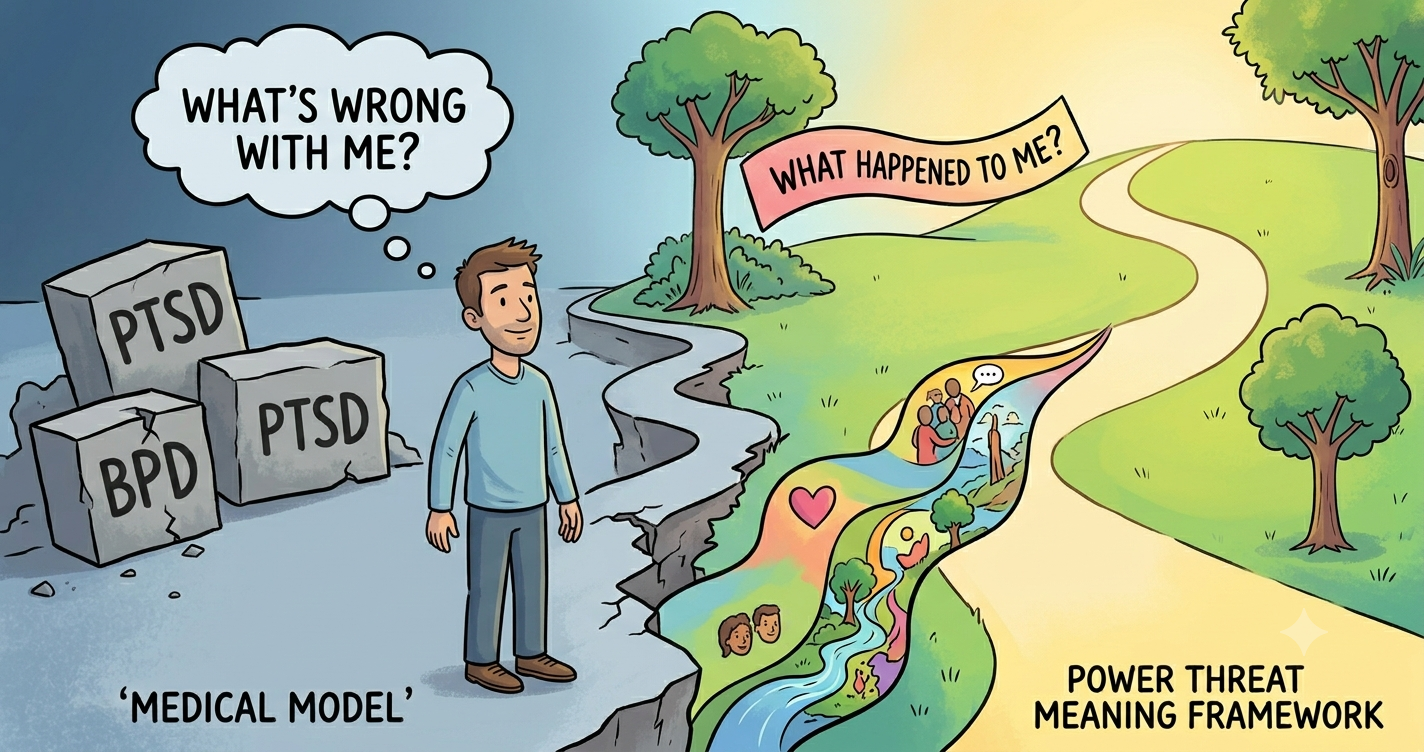
For decades, when we’ve struggled with overwhelming anxiety, deep depression, or confusing voices in our heads, we’ve been handed a single question: “What’s wrong with you?”
The answer usually comes in the form of a label, an acronym like OCD, BPD, or PTSD. But what if that’s the wrong question entirely? What if, instead of asking what is “broken” inside us, we started asking a radically different set of questions: “What happened to you?” and “How did you survive it?”
Power Threat Meaning Framework (PTMF). Developed by the British Psychological Society, this groundbreaking alternative to psychiatric diagnosis isn’t just a new theory; it’s an invitation to change the conversation entirely.
By the end of this piece, I want to give you a new lens. A way of understanding mental distress that doesn’t start with “what’s your diagnosis?” but with “what’s your story?” And I want to show you why that shift, from what’s wrong with you to what happened to you, might be the most important question we can ask.
Quick disclaimer before we dive in: I’m Maryam, a digital journalist with a background in psychology and counseling. This newsletter is just me, no corporate sponsors, no agenda, just someone obsessed with understanding why people are the way they are. What I’m sharing here comes from my research and my psychological lens. It’s an interpretive framework, not the final word. But I hope it gives you a new way to see.
Table of Contents
The Medical Model: What It Gets Right and What It Misses
Let me ask you something.
If you went to your doctor with chest pain, what would you want them to do? Run tests, right? Check your heart, your blood pressure, maybe do an ECG. Find the physical cause of the problem.
Now imagine going to a therapist with depression. What’s the equivalent of running tests? For most of the last century, psychiatry’s answer has been: find the diagnosis. Categorise the symptoms. Treat the “illness” like you’d treat any other disease.
Makes sense on the surface, doesn’t it?
But here’s where it gets complicated.
That chest pain? Doctors can run actual tests that show what’s happening in your body. They can measure your heart function, see blockages, detect inflammation. The symptoms point them toward physical evidence.
Psychiatry doesn’t have that. There’s no blood test for schizophrenia. No brain scan that diagnoses depression. No biomarker that confirms anxiety.
Psychiatry relies entirely on symptoms, what you tell them, what they observe. And symptoms are interpreted through a lens that’s shaped by culture, context and social norms.
The medical model of mental health makes three key assumptions:
Assumption 1: Mental illnesses should be viewed as diseases with a specific organic basis. There’s something physically wrong in the brain or body causing the problem.
Assumption 2: Mental illnesses fall into clear diagnostic categories. Different conditions have distinct symptoms and boundaries.
Assumption 3: There’s a clear boundary between “well” and “ill.” You either have the condition or you don’t.
Here’s the thing: all three of these assumptions have been challenged, systematically, repeatedly, by decades of research.
Take the first one. Yes, there are biological correlates of mental distress. Of course our brains are involved, our brains are involved in everything we do and feel. But the idea that depression is “caused by a chemical imbalance” in the same way diabetes is caused by an insulin problem? The evidence for that is… let’s say, much messier than the pharmaceutical ads would have you believe.
And the second assumption? Research by people like Richard Bentall (link to Bentall, 2003) has shown that diagnostic categories have surprisingly low reliability. Different clinicians looking at the same person often come up with different diagnoses. People frequently fit multiple categories at once, what psychiatry calls “comorbidity.” Kirk and colleagues (link to Kirk et al., 2013) and Moncrieff (link to Moncrieff, 2008) have documented how these categories overlap and blur.
The third assumption might be the most interesting one. Because it turns out the boundary between “well” and “ill” isn’t clear at all.
When Diagnosis Does More Harm Than Good
I want you to imagine something.
You’ve been struggling. Life has been hard, maybe you lost someone, maybe you’re under crushing stress, maybe things happened to you that you never talk about. You finally gather the courage to seek help. You sit across from a professional and tell them your story.
And they listen, nod and say: “Based on what you’re describing, I think you have [insert diagnosis here].”
How would that feel?
For some people, a diagnosis brings relief. There’s a name for this. I’m not alone. Other people have this too. There’s treatment.
But for many others, diagnosis does something else entirely. Something that can be quietly devastating.
Here’s what critics of the diagnostic approach have documented:
Diagnosis can obscure personal meaning. When your distress gets labeled as an “illness,” it becomes disconnected from your life. It’s not about what happened to you anymore, it’s about this thing you have, this pathology living inside you. The connection between your experiences and your suffering gets severed.
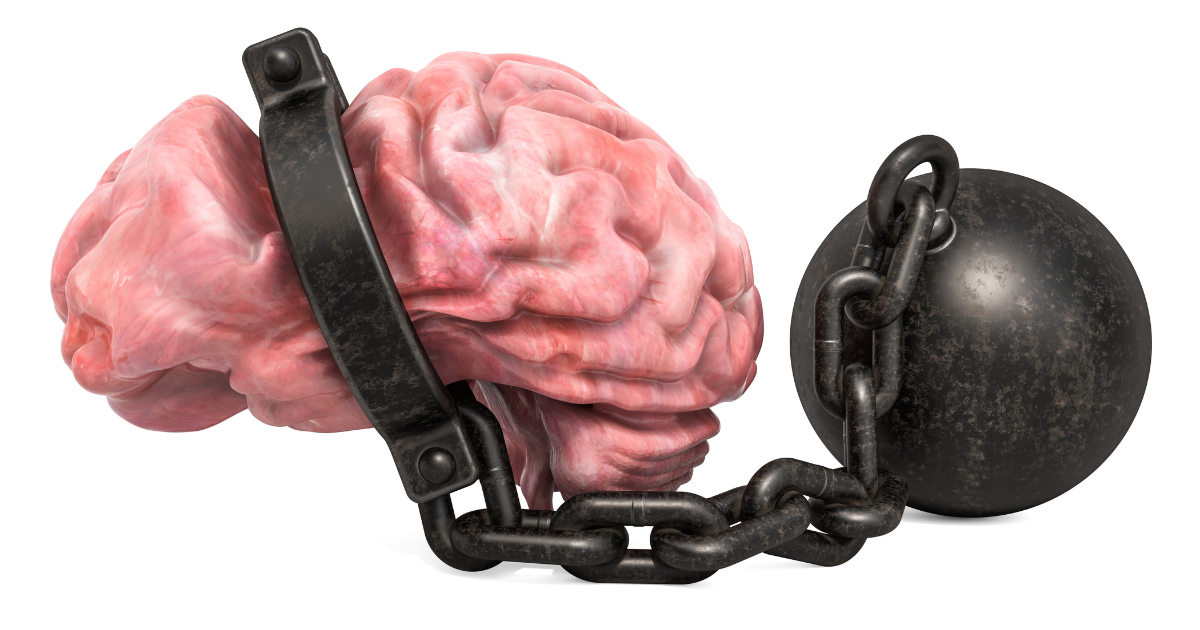
Diagnosis can damage your sense of identity. “I have diabetes” doesn’t change who you are. “I am a schizophrenic” does. The language of diagnosis often becomes identity, and that identity comes with shame, with stigma, with the sense that you are fundamentally different, fundamentally flawed.
Diagnosis can undermine agency. If this is an illness, something that happened to you rather than something you’re responding to, then what can you do about it? You become passive. The expert becomes the one with the answers. Your own knowledge of your life gets devalued.
Diagnosis can take away hope. Some diagnostic labels carry grim prognoses. They become prophecies. People are told they have a “chronic condition” and come to believe they’ll never get better.
This isn’t abstract theory. I’ve sat with people who’ve been told they have “schizophrenia” and watched their faces fall as they absorbed what that meant in the world’s eyes. I’ve also sat with people who later learned to see their experiences differently, not as symptoms of a disease, but as understandable responses to unbearable circumstances.
The label can trap you. Or, with the right framing, it can be set aside entirely.
The Crazy People Living Among Us (And Why That Matters)
Here’s a question that kept me up at night in grad school: if mental illness is real and diagnosable and distinct from “normal” experience… then why do so many “normal” people have symptoms?
Think about it. Population surveys keep finding the same thing: lots of people experience things that would meet diagnostic criteria for mental illness… and never seek treatment, never get diagnosed and function perfectly well.
One study by Tein (1991) found that 11.1% of the general population had experienced hallucinations at some point in their lives. Van Os and colleagues (2000) found similar numbers, 7.9%. Poulton and colleagues (2000) found 13.2% for hallucinations and 12.6% for delusional-type beliefs.
Let me put that in plain language: somewhere between one in thirteen and one in eight people you know has heard or seen something that wasn’t there. Has held beliefs that others might call delusional.
And they’re fine. They’re working, loving, living, functioning. They’re your coworkers, your friends, your family.
What this tells us is profound: the boundary between “well” and “ill” isn’t a wall. It’s a blurry, permeable line that people cross back and forth throughout their lives. Experiences that get labeled as “psychotic symptoms” exist on a continuum with normal human experience.
There are a lot of happy, functioning “crazy” people in the population. They just haven’t been caught in the diagnostic net.
This matters because it challenges the whole foundation of the medical model. If these experiences are so common, if they don’t automatically lead to distress or disability, then maybe they’re not “symptoms” of a “disease.” Maybe they’re just… human. Maybe the question isn’t “what’s wrong with you that you hear voices?” but “what’s different about people who hear voices and struggle versus people who hear voices and don’t?”
And that question leads us somewhere else entirely.
Recovery: What Does It Actually Mean?
So if the medical model has problems, what’s the alternative?
For the last few decades, mental health services have been shifting toward something called the “recovery approach.” It sounds good, who doesn’t want recovery?, but the word turns out to be surprisingly slippery.
Here’s how different people define recovery:
For some, recovery means symptom remission. The voices go away. The depression lifts. You get “back to normal.”
For others, recovery means something else entirely. It means living a meaningful life alongside the voices. It means managing the depression well enough to work, love, create. It means building a life worth living, even if the symptoms never fully disappear.
These are radically different visions.
The recovery approach, as it’s developed in mental health services, is built on several key principles:
- Hope is central. Not false optimism, but genuine belief that things can get better.
- Life roles matter, work, relationships, meaningful activity.
- Spirituality and culture are recognised as important.
- Social connections and community belonging are part of healing.
- The person directs their own recovery. Professionals support, not dictate.
Research by Kidd and colleagues (2011) (link to Kidd et al., 2011) has shown that recovery-oriented services can lead to better outcomes. People do better when they’re treated as partners in their own healing.
But, and this is important, some critics like Harper and Speed (2014) (link to Harper & Speed, 2014) argue that “recovery” is still poorly defined. And even in recovery-oriented services, the old deficit model often persists. There’s still an underlying assumption that something is wrong with the person, even if we’re nicer about treating it.
To move beyond good intentions, we need something else. A framework that actually connects the social causes of distress to individual experiences. A way of understanding that doesn’t pathologise but makes sense of why people do what they do.
The Power Threat Meaning Framework: A New Way Forward
I want you to think about a time when you were really struggling. When life felt overwhelming and you weren’t sure how to cope.
Now ask yourself: did that struggle come out of nowhere? Or was it connected to things happening around you, relationships, money, work, loss, injustice?
Most of us, if we’re honest, can trace our hardest moments back to something. A breakup. A death. Financial stress. Discrimination. Trauma. The slow accumulation of a thousand small cuts.
But the mental health system rarely asks about those things. It asks about symptoms, not causes. It categorises, but doesn’t connect.
What would it look like to build a framework that starts with the connections?
The Power Threat Meaning Framework (PTMF) was developed as an alternative to traditional psychiatric diagnosis. It’s the work of many people, clinical psychologists, service users, survivors, activists, who wanted something better.
Instead of asking “what’s wrong with you?” the PTMF asks four core questions:
1. “What has happened to you?” (How has power operated in your life?)
2. “How did it affect you?” (What kinds of threats did this pose?)
3. “What sense did you make of it?” (How did you interpret these experiences?)
4. “What did you have to do to survive?” (What coping strategies did you adopt?)
See the difference? The medical model asks “what’s your diagnosis?” and then treats the “symptoms.” The PTMF asks about your life, your experiences, your meaning-making and your survival strategies.
And then it adds a fifth question: “What are your strengths?” What power resources do you have access to? What supports, skills, relationships and community connections can help you heal?
This framework doesn’t deny that people struggle. It doesn’t pretend that distress isn’t real. It just reframes the whole thing: your responses to threat aren’t pathology. They’re adaptations. They’re what any human might do in impossible circumstances.
How Power Shows Up in Our Lives
When you hear the word “power,” what comes to mind? Politics? Money? The boss who can fire you?
Those are part of it. But power is so much bigger than that. It’s woven into every aspect of our lives, often in ways we don’t notice.
The PTMF identifies multiple forms of power that shape our experiences:
- Economic power – Having resources or not having them. The power to buy, to own, to access.
- Interpersonal power – Power in relationships. Who looks after whom. Who can hurt whom. Who controls whom.
- Embodied power – Power tied to our bodies. Physical attractiveness, strength, health, disability. The way bodies are valued or devalued.
- Coercive power – Force, violence, threats. The power to make someone do something through fear.
- Social and cultural capital – Education, connections, knowledge. The things that ease your path through life and can be passed to your children.
- Ideological power – This might be the most important one. Control over meaning, language and ideas. The power to define what’s “normal,” what’s “crazy,” what’s “acceptable.”
Ideological power shapes how we interpret our own distress.
When society tells you that your suffering is a “chemical imbalance” rather than a response to injustice, that shapes how you understand yourself. When cultural messages say that “successful people don’t struggle,” that adds shame to whatever you’re already carrying. When the language of mental health focuses on individual pathology rather than social causes, it obscures the real sources of pain.
The PTMF asks: what forms of power have shaped your life? What have you had access to? What have you been denied? Who has power over you and how have you navigated that?
These aren’t abstract questions. They’re the stuff of real lives.
Why We Do What We Do to Survive
I want to talk about some of the things people do when life gets hard.
Withdraw from others. Drink too much. Work obsessively. Starve themselves. Hear voices. Dissociate. Hurt themselves. Push people away. Cling too tightly.
From the outside, these behaviours can look strange. Irrational. Self-destructive.
But here’s the thing: every single one of them makes sense when you understand the context. Every single one is a response to threat. And every single one serves a function.
The PTMF calls these “threat responses.” They’re what we do to survive when power operates against us. And they’re incredibly varied:
Regulating overwhelming feelings:
- Dissociation (checking out when things are too much)
- Self-injury (physical pain to manage emotional pain)
- Memory suppression (forgetting what you can’t bear to remember)
- Using alcohol or drugs (numbing, escaping)
- Binge eating or restricting (controlling something when everything else is out of control)
- Hearing voices (when internal experience becomes externalised)
Protecting against attachment loss and hurt:
- Rejecting others before they can reject you
- Distrust that keeps you safe from betrayal
- Seeking care in ways that might seem “needy”
- Self-blame that gives you illusion of control
- Self-silencing to avoid conflict or abandonment
- Perfectionism to prove your worth
Responding to danger:
- Hypervigilance (always scanning for threat)
- Fighting back (aggression as protection)
- Freezing (immobility when action is impossible)
- Fleeing (escape, avoidance, withdrawal)
None of these responses are “crazy.” They’re human. They’re what our brains and bodies do when threatened. The problem isn’t the response, it’s that the response, which once protected you, may now be causing problems of its own. It may have outlived its usefulness.
The question isn’t “how do I stop this behavior?” It’s “what was this behavior trying to help me survive? And how can I meet that need now, in safer ways?”
Two Stories: Liam and Nadia
Sometimes frameworks make more sense when we see them applied to real lives. So let me introduce you to two people.
These aren’t real clients, they’re composites, drawn from the kinds of stories I’ve encountered in my work. But the details are real and the patterns are real.
Liam’s Story
Liam is 45. He lost his job three years ago when his company downsised. He lives in an area with few opportunities and despite sending out countless applications, he hasn’t found stable work. His savings are gone. His social circle has shrunk, he avoids old friends because he’s ashamed of how far he’s fallen. He spends most days alone, watching TV, drinking more than he should.
Power: Economic power, Liam has none. He can’t control his material circumstances. Ideological power, societal messages about male success and productivity tell him he’s a failure for not providing, for not working, for not being “a real man.”
Threat: Social exclusion. Financial insecurity. The threat of homelessness. The threat of complete worthlessness in a world that measures men by their jobs.
Meaning: Liam interprets his situation as personal failure. He’s not seeing the structural forces, the economic changes, the lack of opportunities, the stigma that makes employers overlook older workers. He blames himself.
Threat responses: Withdrawal from others. Drinking to numb the pain. When he does get temporary work, he becomes a perfectionist, overworking to prove his worth, then crashes when the job ends.
Liam isn’t “depressed” in the sense of having a brain disease. He’s responding, understandably, to an impossible situation.
Nadia’s Story
Nadia is 35. For years, she was in a relationship with a man who controlled everything, her money, her friendships, her access to family. He isolated her, then the abuse started. Emotional, then physical. She felt trapped, powerless, unable to leave.
Power: Interpersonal power, her partner controlled her daily life. Coercive power, violence and threats kept her in line. Ideological power, cultural messages about keeping the family together, about not bringing shame, about being a “good wife” made leaving feel impossible.
Threat: Physical safety. Emotional well-being. Social identity. The threat of being destroyed if she stayed, and destroyed if she left.
Meaning: For years, Nadia made sense of it by believing she was somehow at fault. If she could just be better, more compliant, more loving, he’d stop. This is a common meaning-making strategy in abusive situations, it gives the illusion of control. If it’s my fault, then I can fix it by changing myself. If it’s just him, then I’m truly powerless.
Threat responses: Hypervigilance, constantly scanning for his mood changes, trying to anticipate and avoid conflict. Dissociation, checking out during the worst moments, protecting herself by not being fully present. Self-blame, the story she told herself to survive.
Nadia isn’t “mentally ill.” She’s a survivor whose coping strategies kept her alive in an impossible situation.
What This Means for All of Us
So where does this leave us?
If the medical model is incomplete, if diagnosis can do harm, if recovery means different things to different people, if power shapes our experiences, if our “symptoms” are actually survival strategies… what do we do with all of this?
The PTMF isn’t saying that distress isn’t real. It’s not saying that people don’t suffer or that they don’t need help. It’s saying that we’ve been asking the wrong questions.
And when you ask better questions, you get better answers.
Here’s what the Power Threat Meaning Framework offers:
A way out of shame. When you understand that your responses were survival strategies, not symptoms of a broken brain, you can stop blaming yourself. You were doing the best you could with what you had.
A way to make meaning. Instead of your life being reduced to a diagnostic label, your story becomes central. You’re not a collection of symptoms, you’re a person with a history and that history matters.
A way to find hope. If your distress is connected to power and threat, then changing power dynamics and reducing threats can change your distress. You’re not stuck with a lifelong “illness.” You’re a person who can find new ways to respond, new resources, new supports.
A way to see the bigger picture. The PTMF doesn’t just focus on individuals. It points to social change. If poverty causes distress, we need to address poverty. If discrimination harms mental health, we need to fight discrimination. If trauma is widespread, we need to prevent trauma.
This isn’t just about changing how we do therapy. It’s about changing how we understand human suffering, and what we’re willing to do about it.
Conclusion: The Question We Should Be Asking
I keep coming back to that first abnormal psychology lecture. All those diagnostic categories. All those symptom lists. All that time spent learning to categorise human suffering.
What I know now that I didn’t know then is this: the most important question isn’t “what’s wrong with you?” It’s not even “what happened to you?” It’s “how did you survive?”
Because everyone who walks into a therapist’s office has survived something. Everyone who struggles has been fighting a battle. Everyone who’s been labeled “mentally ill” has been responding, as best they could, to the threats and powers arrayed against them.
The Power Threat Meaning Framework gives us a way to see that. To honour the survival. To understand the meaning. To recognise the power dynamics. And to help people write new stories, stories where they’re not broken, not sick, not defective. Stories where they’re human. Stories where they’re whole.
A small action you can take is to pause the next time you notice distress in yourself or others and ask, “What might this be a response to?” rather than jumping to labels.
To continue exploring this lens, read next: “Culture, Diversity, and Mental Health: Why Your Mind Doesn’t Exist in a Vacuum.”
10 FAQs
Are you saying medication never helps? That seems extreme.
Not at all. Medication can be helpful for many people. The question isn’t whether medication works, it’s whether we’ve reduced human distress to a “chemical imbalance” that medication alone can fix. For some people, medication reduces symptoms enough that they can do the real work of healing. For others, it’s not helpful or has side effects that outweigh benefits. The PTMF doesn’t forbid medication, it just puts it in context as one possible response, not the whole story.
If I have a diagnosis, are you saying it’s not real?
I’m saying diagnoses are categories we’ve created, not diseases we’ve discovered. Your experiences are real. Your suffering is real. But the diagnostic label is a map, not the territory. And maps can be drawn in different ways. Some maps help you find your way; others get you lost.
Doesn’t the medical model reduce stigma by showing it’s “an illness like any other”?
That was the intention and for some people it has helped. But research suggests it hasn’t reduced stigma as much as hoped, and it’s created new problems. Calling something an “illness” can make people feel more different, not less. And it can obscure the social causes of distress, leading to solutions focused on individuals rather than societies.
What about people with diagnoses like schizophrenia who genuinely seem different from “normal”?
Every human experience exists on a continuum. Some people have experiences that are more intense, more persistent, more distressing than others. The PTMF doesn’t deny that. It just asks: what happened to this person? What threats did they face? What meaning did they make? What were they trying to survive? Those questions lead to different kinds of help than simply “treat the illness.”
How do I know if my distress is “understandable” or if I need “real help”?
This is exactly the binary the PTMF wants to break down. Your distress is always understandable. And you might still need help, lots of it. The two aren’t opposites. You can have completely understandable responses to impossible situations and need support, therapy, community, medication or all of the above. Understanding doesn’t mean dismissing.
Can the PTMF be used for children?
Absolutely. In fact, it’s arguably even more important for children, who have less power and are more shaped by their environments. Understanding a child’s behaviour as a response to threat, rather than as a “disorder,” changes everything about how we help them.
What about people who can’t remember trauma? Does that mean the PTMF doesn’t apply?
Not at all. The PTMF isn’t about finding a single traumatic memory. It’s about understanding the patterns of power and threat in someone’s life. Some of those patterns may be obvious; others may be invisible even to the person living them. The framework leaves room for complexity and uncertainty.
How do I find a therapist who uses this approach?
The PTMF is still relatively new, so you might not find someone who explicitly advertises it. But you can look for therapists who:
– Ask about your life, not just your symptoms
– Are interested in your history and context
– Don’t rush to diagnose
– Treat you as a partner in your own healing
– Understand social factors like poverty, discrimination and trauma
Doesn’t this let people off the hook for harmful behaviour?
Understanding isn’t excusing. The PTMF can help us understand why someone did something harmful, what threats they were responding to, what survival strategies they developed, without saying that harm is okay. Accountability and understanding can coexist. In fact, real accountability often requires understanding.
What’s one thing I can do with this information?
Start asking different questions. When you notice yourself or someone else struggling, don’t jump to “what’s wrong?” Ask “what happened?” Ask “what are they responding to?” Ask “what are they trying to survive?” See where those questions lead. They might just change everything.
