
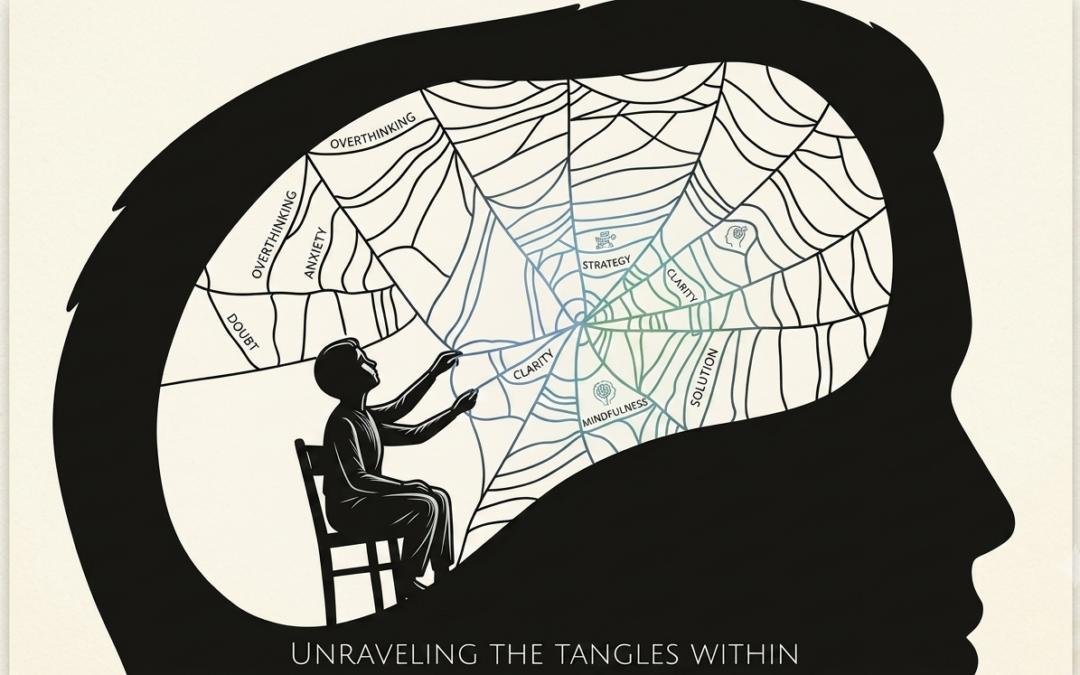
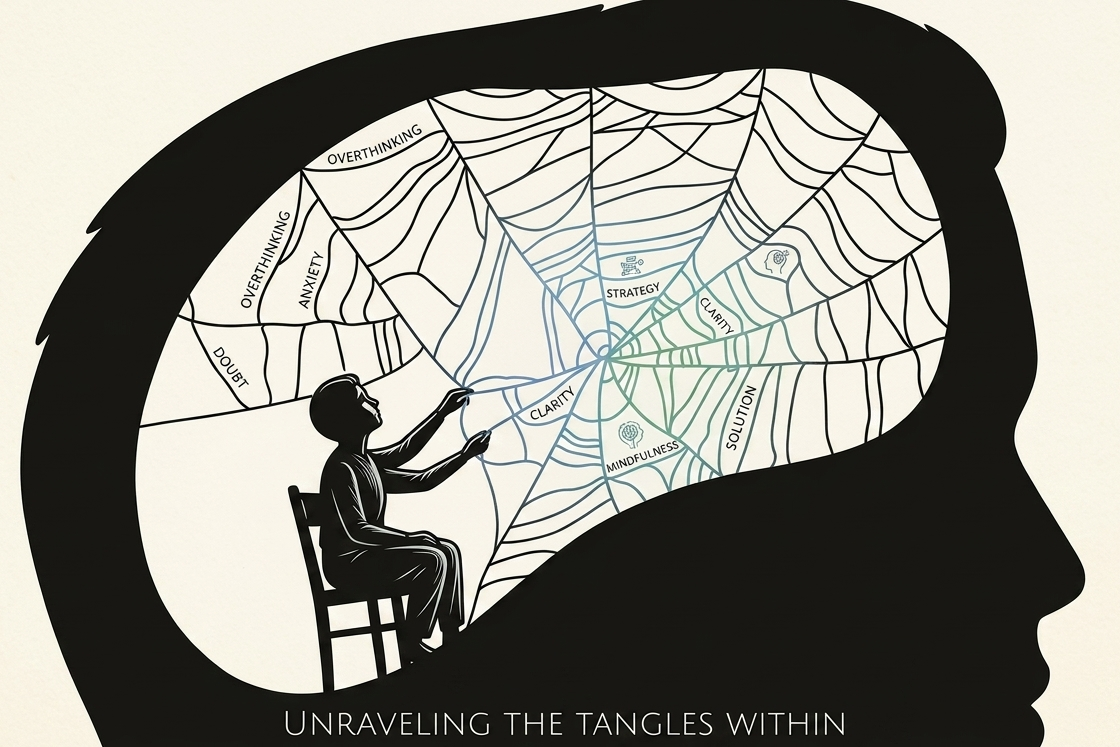
Here’s something that kept me awake this week: A 19-year-old student walks into a room, voice so quiet people constantly say “Huh?” when he speaks. He’s convinced he looks “small, puny, visibly shaking with anxiety, with a strange, inaudible voice.” He believes he looks and sounds ridiculous. Women? He’s never approached one. Freezing up, saying something stupid, that’s the future he sees every time.
Now here’s what haunts me: Is he wrong about himself? Or is his brain just… lying to him?
I’ve spent weeks immersed in the archives of cognitive and behavioural therapies, including Cognitive Behavioural Therapies, watching session footage, reading case notes from Albert Ellis and Aaron Beck, tracking how a philosophical idea from 1st century Stoics became the NHS’s treatment of choice for millions of people. And honestly? The deeper I went, the more unsettled I became. Because the core insight of CBT isn’t complicated: your thoughts shape your feelings. But the implication? That’s the part that kept me up.
What if the voice in your head, the one you’ve trusted your entire life, is actually an unreliable narrator?
The analysis that follows comes from my research across therapy transcripts, clinical studies and the historical context that shaped these approaches. Consider this an interpretive lens, not clinical advice, my attempt to understand why a set of techniques that started with a philosopher in 1st century Greece ended up becoming the dominant force in modern psychotherapy.
Author Disclaimer: I’m a digital journalist with a background in psychological research and documentary storytelling. The analysis presented is based on my study of cognitive and behavioural therapies, including Cognitive Behavioural Therapies, session recordings and the historical documents available. It represents my psychological perspective, an attempt to understand the why behind the therapy, not a clinical guide or definitive treatment manual.
Table of Contents
The Ancient Idea That Became Modern Therapy’s Superpower
Imagine you’re sitting in a room in 1st century Greece. A philosopher named Epictetus is teaching his students and he says something that will echo across two thousand years:
“What disturbs people’s minds is not events, but their judgements on events.”
Now fast forward to 1599. William Shakespeare is writing Hamlet and he puts these words into the protagonist’s mouth:
“There is nothing either good or bad, but thinking makes it so.”
Why did this idea, that our thoughts shape our reality, keep showing up across centuries, across cultures, across completely different worldviews? And more importantly: what does it mean that a philosophical observation from ancient Greece became the foundation of the most empirically validated therapy in modern psychology?
Here’s the thing about Epictetus and Shakespeare: they were observers of human nature, not scientists. They noticed something true about how we operate, but they couldn’t prove it. They couldn’t show you the mechanism.
Fast forward to 1962. Two researchers named Schacter and Singer run an experiment that changes everything. They give participants injections of adrenaline, which creates physiological arousal: heart racing, palms sweating, that familiar “something’s happening” feeling. But here’s the twist: they also manipulate the environment. Some participants are placed with a confederate acting euphoric, playful, happy. Others are placed with a confederate acting angry.
The result? Participants “caught” the emotion of whoever they were with. The same physiological state, pure arousal, became “happiness” in one context and “anger” in another.
This is the moment the philosophical observation becomes scientific evidence. Your body doesn’t tell you what you’re feeling. Your interpretation does. The thought comes first. The feeling follows.
The psychological insight here is both simple and revolutionary: You are not at the mercy of your feelings. You’re at the mercy of your interpretations, and interpretations can be examined, questioned and changed.
This is the foundational bet of every cognitive and behavioural therapy: that by changing how you understand events, you can change how you feel about them. Not through positive thinking. Not through denial. Through accurate thinking, seeing situations as they actually are, not as your distorted interpretations paint them.
The cost of not understanding this? You remain a passenger in your own mind, carried along by thoughts you never chose, never questioned, never even noticed were there.
Six Principles That Rewired Psychotherapy
Cognitive Behavioural Therapy isn’t one thing. It’s an umbrella term for a whole family of approaches, REBT, CT, MBCBT, DBT, ACT, that share a common DNA. But what exactly is that DNA? What principles do all these approaches agree on?
What are the non-negotiable beliefs that unite every therapist who calls themselves “cognitive behavioural”?
I spent weeks tracking through the literature and here’s what I found: six principles that show up again and again, across every wave, every technique, every therapist.
Principle 1: Beliefs shape how we feel about events. The Epictetus principle. The cognitive model says there’s always a B (belief) between A (activating event) and C (emotional consequence). Always.
Principle 2: What we do has a powerful influence on our thoughts, feelings and choices. This is the “behavioural” part, the recognition that action isn’t just an outcome of thinking; it’s a cause of thinking. Change what you do and you change what you feel.
Principle 3: Psychological problems can be understood as exaggerations of normal processes. This one stopped me. It means the difference between “healthy” and “struggling” isn’t qualitative, it’s quantitative. We all have negative thoughts. We all have unhelpful beliefs. The question is: have they become rigid, extreme, absolute?
Principle 4: It’s usually more fruitful to focus on current processes rather than past events. CBT doesn’t deny your history. It just asks: what can we do now? The past is fixed. The future is uncertain. The only place you can intervene is the present moment.
Principle 5: Problems can be understood as interactions between thoughts, emotions, behaviour, physiology and environment. Nothing exists in isolation. Your thoughts affect your body. Your body affects your behaviour. Your behaviour affects your environment. And it all loops back.
Principle 6: The practice of psychological therapies should be guided by finding out what works. This is the scientist-practitioner model. Test everything. Keep what helps. Discard what doesn’t.
What emerges from these six principles is a radically democratic vision of therapy. The therapist isn’t a guru with secret knowledge. They’re a co-investigator, someone who collaborates with you to test whether your thoughts are accurate and your behaviours are helpful.
This is what Aaron Beck called “collaborative empiricism.” You and your therapist, side by side, designing experiments to find out what’s true. Not what feels true. What is true.
The Three Waves: How CBT Evolved (and Why It Keeps Changing)
Here’s something that surprised me: CBT isn’t a static thing. It’s more like a living organism that’s evolved over decades, absorbing new insights, dropping what doesn’t work, adapting to new evidence. Therapists talk about “waves”, three distinct phases in the development of cognitive and behavioural approaches.
Why did CBT need to evolve? And what does each wave tell us about where we’re heading?
First Wave: Behavioural Therapies (1950s-60s). This was the rebellion against psychoanalysis. Instead of talking about unconscious conflicts, behaviourists said: focus on what you can see. Focus on behaviour. Desensitisation therapies. Behaviour modification. The core insight: you can change how you feel by changing what you do. Simple. Measurable. Effective.
Second Wave: Cognitive Therapies (1970s-80s). Then came the cognitive revolution. Albert Ellis and Aaron Beck, working independently, realised that behaviourism missed something crucial: the thoughts driving the behaviour. They brought cognition back in. Rational Emotive Behavioural Therapy. Cognitive Therapy. Cognitive Behaviour Modification. The core insight: thoughts mediate between events and emotions. Change the thought, change the feeling.
Third Wave: Mindfulness & Acceptance Based Approaches (1990s-present). And then something shifted again. Therapists started noticing that fighting with thoughts could be as problematic as the thoughts themselves. Mindfulness-Based CBT. Dialectical Behaviour Therapy. Acceptance and Commitment Therapy. The core insight: maybe the goal isn’t changing thoughts, maybe it’s changing your relationship to thoughts. Letting them come, letting them go, without getting tangled.
What fascinates me about this evolution is that each wave doesn’t replace the previous one, it adds to it. Third wave therapists still use behavioural techniques. They still work with cognition. But they’ve added something new: acceptance, mindfulness, compassion.
The psychological insight here is about the nature of progress itself. We tend to think of scientific progress as replacing old ideas with better ones. But in therapy, progress often looks like integration, adding new layers of understanding without discarding the wisdom that came before.
For those interested in the research on third-wave approaches, here’s a summary of key studies.
Albert Ellis and the Art of “Musturbation”
Albert Ellis was not a man who suffered fools gladly. He was direct, confrontational and completely unafraid to tell clients they were making themselves miserable. In the 1950s, when psychotherapy was dominated by Freudian analysts who saw patients for years, Ellis developed something radically different: Rational Emotive Behavioural Therapy (REBT).
What kind of person creates a therapy that tells people their suffering is self-inflicted? And why did so many people find it liberating rather than offensive?
Ellis drew on ancient philosophers, Zeno, Epicurus, Epictetus, Marcus Aurelius, Confucius, Buddha, Lao-Tsu. He saw himself as taking “the most practical aspects of their teachings” and turning them into a therapeutic method.
His central insight was simple: we make ourselves miserable not because of what happens, but because of what we demand should happen. Ellis had a wonderful term for this: “musturbation.” The belief that things absolutely must be a certain way.
Ellis identified three core irrational beliefs that drive self-defeating behaviour:
Belief 1: “I absolutely must perform important tasks well and be approved by significant others, or else I am an inadequate, worthless person.” Result? Anxiety, depression, demoralisation.
Belief 2: “I must live a comfortable, unhassled, enjoyable life, otherwise it’s awful and I can’t stand it.” Result? Low frustration tolerance, addiction, avoidance.
Belief 3: “Other people must treat me kindly and fairly, or else they are evil and must be punished.” Result? Anger, rage, violence.
The REBT model uses A-B-C-D-E: Activating event, Belief, Consequence, Disputation, Effect. The therapist’s job? Help clients dispute their irrational beliefs through logic, through imagery, through behaviour.
What Ellis understood, and what makes REBT both brilliant and uncomfortable, is that we’re deeply attached to our misery. Our irrational beliefs feel true. They feel like descriptions of reality rather than interpretations. Disputing them feels like lying to ourselves.
But Ellis would say: test it. Is it really true that you must be approved by everyone? Where’s the evidence? What’s the logical basis for that demand? And when you hold it, what does it cost you?
The psychological insight: much of our suffering comes not from disappointment, but from the demand that disappointment shouldn’t exist. The gap between reality and our demands is where anxiety, depression and rage live.
Aaron Beck: The Psychiatrist Who Listened to His Patients
While Ellis was developing REBT in New York, a psychiatrist named Aaron Beck was doing something revolutionary in Philadelphia. He was listening to depressed patients, really listening, and noticing something everyone else had missed.
What did Beck hear that generations of therapists before him had overlooked?
Beck was trained as a psychoanalyst. He was supposed to be listening for unconscious conflicts, for hidden meanings, for the deep structures of the psyche. But when he listened to depressed patients, he kept hearing the same patterns: negative views of the self, the world and the future.
He called this the Negative Cognitive Triad:
- “I am helpless and inadequate” (negative view of self)
- “All of my experiences result in failure” (negative view of the world)
- “The future is hopeless” (negative view of the future)
Beck noticed that these thoughts weren’t random. They were automatic, popping into consciousness without effort, without invitation. And they were distorted, systematically biased toward the negative.
He identified cognitive schemas: deep structures of belief that shape how we interpret experience. If you grow up believing you’re unlovable, you’ll interpret neutral events as evidence of rejection. If you believe you’re incompetent, you’ll filter out evidence of success.
And he catalogued cognitive distortions, systematic errors in thinking that maintain depression and anxiety. Mind-reading. Catastrophising. Black-and-white thinking. Emotional reasoning. Personalisation. The list goes on.
Beck’s genius was recognising that these weren’t symptoms of illness, they were habits of mind. And habits can be changed.
Cognitive Therapy (CT) became a structured, present-focused, problem-oriented approach. Therapist and client become co-investigators, collaboratively examining thoughts, testing them against reality, designing experiments to see if beliefs hold up.
The psychological insight: depression isn’t just about feeling bad. It’s about thinking in ways that guarantee you’ll keep feeling bad. And thinking, unlike feelings, is something you can learn to observe, question and adjust.
For a deeper dive into cognitive distortions and how to identify them, here’s a practical guide.
Vumile’s Story: What Happens When You Test Your Thoughts
Let me introduce you to Vumile. He’s 19, a student and his life feels miserable. He watches other students living sociable, exciting lives while he sits in his room studying, playing computer games, watching TV. He has a few friends, but they call him “antisocial.” He’s never dated anyone.
When Vumile walks into a room, here’s what he believes about himself: small, puny, visibly shaking, strange inaudible voice, ridiculous. When he considers approaching a woman, he’s certain he’ll freeze up and say something stupid.
What would it take for Vumile to discover that his thoughts might be lying to him?
Vumile’s history is brutal. His parents’ violent quarrels. His father’s affairs. Corporal punishment with belts and metal chains, blood drawn for minor offences. A “boss and slave” relationship with his father. A mother who was unpredictably cruel.
This history shaped his core beliefs: I am inadequate. I am unworthy. I am not safe.
Now those core beliefs produce automatic thoughts in every social situation: “I’m boring.” “I won’t succeed.” “They’ll think I’m a loser.” “They’ll pity me.”
And those thoughts produce behaviour: he avoids speaking up, stays at the edge of groups, averts his gaze, holds his body still. Safety behaviours that make him appear exactly as he fears, awkward, distant, strange.
Here’s the cruel irony: Vumile’s peers mock him and call him “antisocial.” Not because he’s inherently unlikeable. Because his fear makes him act in ways that confirm his fear.
Cognitive therapy with Vumile had three phases:
First, psychoeducation. Understanding how thoughts, feelings, behaviour and physiology interact to maintain anxiety. Seeing the loop he’s trapped in.
Second, examining thoughts. Not accepting them as facts, but treating them as hypotheses. Looking for exceptions. Noticing when the predictions don’t come true. Challenging the unhelpful beliefs.
Third, behavioural experiments. Testing the beliefs through action. Actually approaching people. Actually speaking up. Gathering evidence.
The outcome? His pessimistic thoughts reduced. Anxiety remained, but it no longer prevented engagement. Each behavioural experiment generated positive information about his social skills. Each experiment provided hope.
The psychological insight: Vumile didn’t need to become confident before he acted. He needed to act before he could become confident. The behaviour came first. The belief followed.
Behavioural Experiments: Why Thinking Isn’t Enough
Marcus Aurelius, Roman Emperor and Stoic philosopher, wrote in 180 AD: “Waste no more time arguing about what a good person should be. Be one.”
Two thousand years later, that’s still the core insight of behavioural experiments. You can talk about change forever. You can analyse your thoughts until you’re blue in the face. But at some point, you have to do something.
Why is doing so much more powerful than thinking? And how do you set up experiments that actually work?
Behavioural experiments are planned activities, carried out in sessions or between them, that test existing beliefs and help develop more adaptive ones. They’re not just “trying things out.” They’re hypothesis tests.
Vumile might design an experiment: “I believe that if I speak in a group, people will laugh at me. I’ll test this by making one comment in my seminar and observing the actual responses.”
The key is making experiments “no-lose.” Whatever happens, you learn something. If people don’t laugh, you’ve disconfirmed the belief. If they do laugh, you’ve learned something about that specific situation, and you can design the next experiment accordingly.
Here’s what makes behavioural experiments powerful: they generate evidence that thinking alone can’t access. You can argue with a thought forever, but until you test it, you’re just speculating. The experiment provides data. And data is harder to dismiss than logic.
The psychological insight: beliefs don’t change through argument. They change through experience. You can tell yourself you’re capable, but until you experience capability, the belief remains abstract. Behavioural experiments make the abstract concrete.
This is why CBT isn’t just talk therapy. It’s action therapy. The talking sets up the hypothesis. The action tests it. And the results, real, lived, embodied, create change that lasts.
Conclusion: The Ongoing Experiment
Cognitive and behavioural therapies represent something remarkable: a centuries-old philosophical insight, tested through decades of scientific research, refined through clinical experience and made accessible to millions of people.
At their core is a radical proposition: you are not your thoughts. You are the observer of your thoughts. And as the observer, you have choices. You can question. You can test. You can act differently and see what happens.
The Stoics knew this. Shakespeare knew this. Ellis and Beck built careers on it. And every person who’s ever used a thought diary, challenged a cognitive distortion or designed a behavioural experiment has participated in the same ancient practice: stepping back from your mind long enough to ask, “Is that really true?”
The cost of not understanding this psychology? You remain subject to every thought that passes through your head. You treat your interpretations as facts. You never discover that the voice you’ve trusted your entire life might be, in some ways, an unreliable narrator.
The gain of understanding it? Freedom. Not freedom from difficult thoughts or feelings, but freedom from being ruledby them. Freedom to observe, to question, to choose. Freedom to discover that you’re capable of more than your thoughts ever told you.
Try writing one automatic thought today, label its distortion, and test it with a small behavioural experiment; then read : The Body Knows: What Somatic Psychology Reveals About the Stories We Store in Skin and Bone.
10 FAQs
Does CBT really work for everything?
Research shows strong evidence for depression, anxiety disorders, PTSD and OCD. Evidence is more mixed for complex conditions or severe mental illness. No therapy works for everyone.
Isn’t CBT just positive thinking?
Not at all. CBT aims for accurate thinking, not positive thinking. Sometimes accurate thinking is negative. The goal is realism, not optimism.
How long does CBT take?
Typically 6-20 sessions, depending on the condition and severity. Some people benefit from shorter interventions; others need longer-term work, especially on core beliefs.
Can I do CBT on myself?
Self-help resources (like Moodjuice or SilverCloud) can be helpful for mild difficulties. For moderate to severe problems, working with a trained therapist is strongly recommended.
What’s the difference between CBT and REBT?
REBT is more philosophical and confrontational, focusing on disputing irrational beliefs. Beck’s CBT is more collaborative and empirical, focusing on testing thoughts through experiments. Both are effective.
Does CBT ignore childhood experiences?
It doesn’t ignore them, it uses them to understand how core beliefs developed. But it focuses on changing current patterns rather than endlessly analysing the past.
What if my thoughts are actually true?
CBT doesn’t assume all negative thoughts are false. It helps you examine the evidence and arrive at an accurate assessment. Sometimes the accurate assessment is painful, and then you work on coping with that reality.
Is there neuroscience behind CBT?
Yes. Research shows that CBT can change brain function in areas involved in emotion regulation, cognitive control and fear extinction. The brain’s plasticity means that changing thinking patterns literally changes the brain.
Can children and young people benefit from CBT?
Absolutely. Adapted versions of CBT are effective for children and adolescents with anxiety, depression and behavioural difficulties. The techniques are adjusted for developmental level.
