
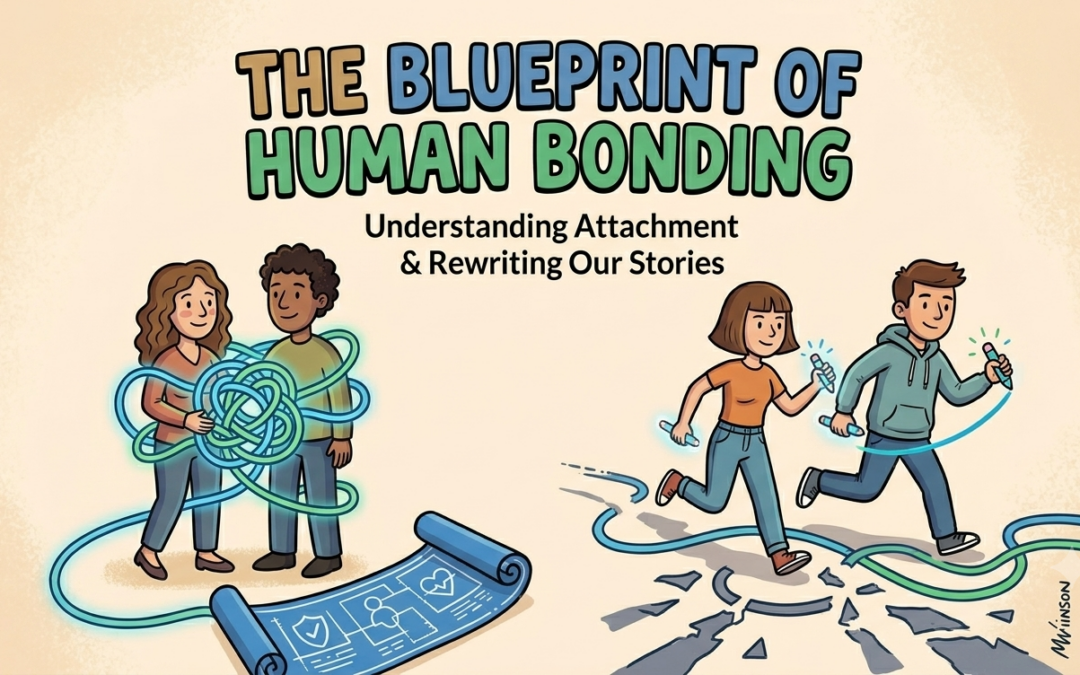
Do you ever catch yourself repeating patterns in relationships, patterns you swore you’d never repeat?
Maybe you’re the one who pulls away when things get too close. Or the one who clings a little tighter, a little longer, than feels comfortable. Maybe you watch friends cycle through the same romantic dynamics, wondering why they can’t seem to escape.
Here’s what I’ve come to understand after years of studying developmental psychology: the way we love as adults is written in the language we learned before we could speak.
Before we had words, we had caregivers. Before we understood ourselves, we were understood, or not understood, by the people who held us. And in those early exchanges, something profound was taking shape: a blueprint for every bond we would ever form.
Attachment theory, first developed by John Bowlby and expanded by Mary Ainsworth, offers us a framework for understanding why we love the way we do. It traces the invisible thread from the nursery to the boardroom, from the playground to the bedroom, from our earliest cries for comfort to our most adult searches for connection.
This isn’t just academic theory. It’s the story of how humans learn to belong.
In this deep dive, we’ll explore what attachment really means, not just the bond between infant and caregiver, but the lifelong dance of proximity, safety and exploration that shapes our relationships at every age. You’ll discover why some of us approach love with confidence while others approach it with caution. You’ll learn what happens when it goes wrong. And you’ll see how understanding your own attachment history might just change how you show up in every relationship you have.
I’m Dr. Deborah Bailey-Rodriguez and this is my documentarian lens on the psychology of attachment.
A quick disclaimer: The analysis presented here is based on developmental psychological research and clinical frameworks. It represents an interpretive lens on human bonding, not a diagnostic tool. If you recognise patterns that concern you, consider speaking with a qualified mental health professional.
Table of Contents
What Is Attachment? More Than Just Love
I want you to think about the person you turn to when the world feels too heavy. The one you call after a bad day. The one whose presence alone seems to make things manageable again.
Now ask yourself: Why that person? What makes them different from all the others?
We tend to think of our closest bonds as mysteries of chemistry and compatibility. We “click” with certain people. We “vibe” with others. The language we use suggests something almost magical about human connection.
But attachment theory offers a different lens. It suggests that our capacity to form close bonds follows predictable patterns that begin to form in our first year of life.
Psychologist John Bowlby, who developed the theory, defined it as “a strong, lasting and affectionate bond that an individual shares with another significant individual, who knows and responds to the other’s needs.” That significant individual becomes an attachment figure, in childhood, typically the primary caregiver; in adulthood, typically a partner or close friend
Bowlby understood something profound about human nature. We are born helpless. Our survival depends entirely on the responsiveness of others. When an infant cries, they’re not just making noise, they’re activating an ancient system designed to bring a caregiver close.
This is the psychological insight that changes everything: Attachment isn’t just about love. It’s about protection. It’s about having someone whose presence signals safety in a world that can feel threatening.
Bowlby himself described attachment as a lifespan theory, “from the cradle to the grave,” he wrote in 1979. The bonds we form as infants set templates for the bonds we’ll seek as adults. Not because we’re trapped by our past, but because our earliest experiences teach us what to expect from love.
The Attachment System: Why We Reach for Others When We’re Scared
Have you ever noticed how a simple hug can change everything? How the presence of someone you trust can literally calm your nervous system, slow your heart rate, make the world feel manageable again?
This isn’t just sentiment. It’s biology. And it operates through the attachment system, the organisation of an individual’s behaviour with a caregiver in relation to threat or distress.
The attachment system activates when we feel:
- Frightened
- In pain or fatigued
- That our caregiver is inaccessible or unresponsive
When that system activates, we engage in attachment behaviours, actions designed to bring us closer to our attachment figure. Three types matter most:
Proximity-seeking: The goal is simply to attain or retain closeness to the person who can provide comfort and protection.
Safe haven: The attachment figure becomes a refuge, somewhere to run when threatened.
Secure base: Once comfort is achieved, the attachment system switches off and we can return to exploring the world, knowing we have somewhere safe to return to.
Here’s what I need you to understand: The goal of attachment isn’t physical proximity. It’s felt security.
A child doesn’t just want their mother in the room. They want to feel her presence as comforting, available, responsive. The same is true for adults. We can be physically alone and feel securely attached because we carry internal representations of our loved ones. We can be in a crowded room and feel desperately alone because our attachment system is activated and no one feels available.
The real goal of attachment is captured in this simple equation:
Behaviour of attachment figure + Child’s internal experience = Felt security
It’s not about what the caregiver does. It’s about what the child experiences them as doing.
Internal Working Models: The Mental Maps We Don’t Know We’re Using
I’d like you to complete this sentence silently: “When I’m really struggling, other people are usually…”
Your answer might be “there for me” or “too busy” or “overwhelming” or “unreliable.” Whatever came to mind, you just accessed something attachment researchers call your internal working model.
Here’s what’s fascinating about these models: they operate below conscious awareness. We don’t actively decide to expect certain things from relationships. We just do. And those expectations shape everything, who we approach, how we react to conflict, whether we trust, whether we cling, whether we flee.
Internal working models (IWMs) are cognitive frameworks, mental representations for understanding the world, self and others. They develop through repeated interactions with attachment figures. A child whose caregiver is warm and sensitive develops a model of others as loving and available and a model of self as loveable and worthy. A child whose caregiver is inconsistent or rejecting develops very different models.
The psychological insight here is both simple and profound: We don’t just learn how to behave in relationships. We learn what relationships are.
Our IWMs become filters through which we interpret every subsequent bond. When a securely attached adult trusts their partner, they’re not just making a decision in the moment. They’re drawing on decades of evidence that people can be trusted. When an insecurely attached adult doubts their partner’s love, they’re also drawing on evidence, just a different kind.
As Kobak and Madsen put it, individuals develop and organise their attachment behaviour during times of distress in ways that seek to increase the availability and responsivity of their attachment figure. The strategies we use, whether we reach out, pull away or do both at once, are shaped by what’s worked in the past.
The Strange Situation: How 20 Minutes Reveals a Lifetime Pattern
Imagine you’re in a lab, watching through one-way glass as a mother and her one-year-old play in an unfamiliar room. A stranger enters. The mother leaves. The child is alone with a stranger. The mother returns. Then everyone leaves and the child is completely alone. Then the stranger returns. Then the mother returns again.
Twenty minutes. Eight episodes. And by the end, researcher Mary Ainsworth could predict, with remarkable accuracy, how that child would approach relationships for years to come.
This is the Strange Situation Task (SST) , the most famous procedure in attachment research. Developed by Ainsworth in the 1970s, it was designed to assess attachment patterns in children aged 10 months to 2 years.
The procedure creates increasing stress for the child through separations and reunions, introducing a stranger and ultimately leaving the child alone. But here’s what matters most: the infant’s responses during the two reunion episodes.
This is when the attachment system is most activated. The child has been stressed. The caregiver has returned. How does the child respond?
Ainsworth identified four indices of attachment security:
- Proximity-seeking
- Contact maintenance
- Resistance
- Avoidance
Based on these patterns, Ainsworth identified three organised attachment categories (with a fourth added later by Main and Solomon):
Secure attachment: Child uses mother as secure base, may or may not be distressed at separation, responds positively at reunion, resumes play, clearly prefers mother to stranger.
Insecure-avoidant attachment: Child explores without using mother as base, appears unaffected at separation, ignores or avoids mother at reunion, treats stranger similarly.
Insecure-resistant (ambivalent) attachment: Child refuses to explore, becomes extremely distressed at separation, displays angry or petulant behaviour at reunion that hampers comforting.
Insecure-disorganised attachment (added later): Child shows no clear strategy, appears disoriented, may freeze or show contradictory behaviours.
The payoff? Attachment patterns aren’t just about behaviour. They’re about strategy. Each pattern represents the child’s best attempt to maintain proximity to a caregiver whose responsiveness varies in predictable ways.
Secure Attachment: The Foundation of Healthy Bonding
Let me paint you a picture of what security looks like in action.
A toddler plays contentedly on the floor, occasionally glancing at their mother, using her presence as a home base for exploration. When she leaves, they may fuss, or they may not. But when she returns, their face lights up. They reach for her, are comforted quickly and soon return to play, ready to explore again.
What makes this pattern possible? The answer lies in the caregiver’s behaviour. Secure attachment develops when caregivers respond appropriately, promptly and consistently to their infant’s needs. Not perfectly, no one is perfect. But predictably enough, the child develops a clear expectation: when I need comfort, comfort will come.
This consistency shapes the child’s internal working models in profound ways.
The securely attached child experiences self as:
- Autonomous
- Capable
- Loveable
- Worthwhile
And experiences others as:
- Attuned
- Loving
- Available
- Predictable
- Dependable
The child can easily express need for protection and comfort because experience has taught them that such expression works. There’s no need to minimise distress or maximise it. Normal signals get normal responses.
Here’s what I love about this pattern: Secure attachment isn’t about never feeling distressed. It’s about knowing, deep in your bones, that distress has a remedy. That you’re not alone with your pain. That someone will come.
Insecure-Avoidant: When Independence Becomes a Shield
Watch this child carefully. They explore the room, seemingly absorbed in toys. When their mother leaves, they barely glance up. When she returns, they actively avoid her, turning away, focusing on play, showing no visible response to her presence.
At first glance, this might look like a remarkably independent toddler. “So self-sufficient,” observers sometimes remark. “Doesn’t even need her.”
But here’s what’s happening beneath the surface. Physiological measures tell a different story. Avoidant infants show elevated heart rates and stress hormones during separation, they are distressed, even if they don’t show it. Their avoidance isn’t indifference. It’s a strategy.
This pattern develops when caregivers show little or no response to a distressed child, when they discourage crying, when they encourage independence at the expense of comfort. The child learns that attachment behaviours don’t work. Reaching out leads to rejection. So they stop reaching out.
The avoidant child’s internal working models tell a painful story:
Self is experienced as:
- Rejected
- Controlled
Others are experienced as:
- Rejecting
- Unloving
- Intrusive
- Predictably unavailable at times of need
To cope, the child minimises attachment behaviours and inhibits feelings. Affect becomes over-regulated, emotions are managed so tightly that even the child may lose access to them.
The psychological insight? Avoidance isn’t strength. It’s protection. The child hasn’t stopped needing. They’ve stopped showing that they need. It’s the difference between not being hungry and having learned that no one will feed you.
[Link: Ainsworth’s research on avoidant attachment patterns]
Insecure-Ambivalent: The Push and Pull of Love
This child is distressed before the mother even leaves. When she departs, the distress becomes overwhelming. But watch what happens when she returns. The child reaches for her, then arches away, angry. Seeks comfort, then resists it. Wants closeness, but can’t accept it.
This pattern, sometimes called resistant or preoccupied attachment, develops in response to inconsistent caregiving. The caregiver is sometimes appropriately responsive, sometimes neglectful. The child can’t predict which mother will show up.
This unpredictability creates a terrible dilemma. The child needs comfort but can’t trust that comfort will come. So they develop a strategy of maximising attachment behaviours, exaggerating distress, clinging, refusing to explore, staying hyper-vigilant to the caregiver’s whereabouts.
The ambivalent child’s internal working models reveal the cost:
Self is experienced as:
- Ineffective
- Dependent
- Low in self-worth
Others are experienced as:
- Insensitive
- Depriving
- Neglecting
- Unpredictable
- Unreliable
Affect becomes under-regulated, emotions spill out unchecked because the child has learned that only big signals get through. If normal distress doesn’t bring comfort, maybe desperate distress will.
The psychological insight? Ambivalent attachment isn’t about being “too needy.” It’s about being caught in an impossible situation. The child needs the very person who has proven unreliable. They can’t stop needing and they can’t trust that need will be met. So they do both, they seek and resist, cling and fight, love and rage.
[Link: Ainsworth’s research on ambivalent/resistant attachment]
Disorganised Attachment: When the Source of Safety Is Also the Source of Fear
Some children in the Strange Situation don’t show a clear pattern at all. They freeze. They rock. They approach the parent with their head turned away. They may start toward the parent, then fall to the floor. Their behaviour seems to have no strategy, no organisation, no coherent approach to getting their needs met.
This pattern, identified later by researchers Main and Solomon, is called disorganised attachment. And it emerges from the most painful caregiving situations, when the attachment figure is also a source of fear.
Caregivers of disorganised children may display:
- Frightened or frightening behaviour
- Intrusiveness or withdrawal
- Negativity or role confusion
- Affective communication errors
- Overt maltreatment
The child faces an impossible paradox. The person they’re wired to seek for safety is the person they need safety from. Their attachment system is chronically activated because threat is constant. But no organised strategy, whether reaching out or pulling away, can resolve the situation.
The disorganised child’s internal working models are devastating:
Self is experienced as:
- Frightened
- Alone
- Rejected
- Dangerous
- Bad
Others are experienced as:
- Stressful
- Frightening
The attachment figure, rather than being a source of comfort, is the cause of fear and distress. Organised attachment patterns fail to achieve proximity or comfort. The attachment system remains chronically activated. Arousal goes unregulated.
The psychological insight? Disorganised attachment isn’t a strategy, it’s the collapse of strategy. When no approach works, the child is left without a coherent way of being. The legacy of this pattern in later life is often profound difficulty with emotional regulation, relationships and mental health.
Multiple Attachments: It Takes a Village (or at Least a Few Good People)
You might be wondering: does it all come down to mother? What about fathers, grandparents, siblings, other caregivers?
Here’s what the research shows: infants can and do form multiple attachment relationships. Usually one person becomes the primary attachment figure, but children also develop attachments to a few close others, secondary attachment figures who provide comfort and security.
A child can be securely attached to mother but insecurely attached to father or vice versa. These different relationships provide different experiences, different models of how relationships work.
The psychological insight? Attachment isn’t a single relationship. It’s a network. The more secure attachments a child has, the more resilient they’re likely to be. Multiple secure attachments provide multiple sources of comfort, multiple models of loving relationships, multiple chances to develop healthy internal working models.
This matters enormously for intervention. When a primary attachment relationship is compromised, other attachments can buffer the child. A grandmother, a teacher, an older sibling, anyone who provides consistent, responsive care, can offer an alternative template for what love can look like.
From Infancy to Adolescence: The Unfolding Story
Fast-forward a decade. That toddler who reached for their mother at reunion is now a teenager, navigating friendships, first crushes and the complex social world of secondary school. What happened to their attachment patterns along the way?
By middle childhood, children start developing closer relationships with peers. By late adolescence, peers tend to be preferred over parents as sources of emotional support and comfort. This looks, on the surface, like “un-attaching” from parents, a pulling away, a transfer of attachment functions to friends and romantic interests.
But here’s what’s happening beneath the surface: a secure relationship with parents remains crucial for developing autonomy.
Research by Fraley and Davis (1997) showed that secure attachment to parents in adolescence predicts healthier peer relationships and greater capacity for autonomy. The teenager who can confidently explore the social world isn’t the one who has cut ties with parents. It’s the one who knows those ties remain, who carries an internal working model of parents as available if needed.
The outcomes tell the story. Compared to insecurely attached children, securely attached children grow into adolescents with:
- More effective problem-solving
- Better affect regulation
- Higher IQ
- More friends and greater popularity
- Better social skills and closer friendships
- Higher self-esteem
- Higher academic achievement
The psychological insight? Secure attachment doesn’t keep children dependent. It makes them brave. Knowing you have a safe base makes exploration possible, not impossible.
Adult Attachment: Do We Love Like We Were Loved?
Here’s the big question that brought many of you to this article: Do our earliest attachments shape how we love as adults?
The short answer is yes. But the long answer is more interesting.
In 1987, researchers Hazan and Shaver asked a provocative question: Are adult romantic relationships governed by the same behavioural and motivational system as infant-caregiver attachments?
They identified striking parallels:
- Both feel safe when the other is nearby and responsive
- Both engage in close, intimate, bodily contact
- Both involve being preoccupied and fascinated with the other
They conceptualised romantic love as an attachment process. But there’s a crucial difference: adult attachments are symmetrical. Both partners give and receive care. Both serve as attachment figures for each other.
Building on this work, Bartholomew and Horowitz (1991) developed a four-category model of adult attachment based on internal working models of self and others. Each of us holds, often unconsciously, a view of ourselves as worthy or unworthy of love and a view of others as trustworthy or untrustworthy.
These models combine to create four adult attachment styles:
Secure attachment (positive view of self and others): Comfortable with both autonomy and closeness. Trusting of others. Seeks and accepts support when needed.
Preoccupied (anxious) attachment (negative view of self, positive view of others): Low self-esteem and self-worth. High need for access to attachment figure. Low sense of autonomy. Fear of abandonment.
Dismissing (avoidant) attachment (positive view of self, negative view of others): Suppresses attachment-related thoughts and emotions. Distances when stressed. Self-reliant. Uncomfortable with closeness.
Fearful (disorganised) attachment (negative view of self and others): Unresolved around loss or trauma. Contradictory behaviours, intensely seeks intimacy but fears rejection. Lacks trust.
Alternatively, adult attachment can be measured along two dimensions: attachment anxiety (fear of rejection/abandonment) and attachment avoidance (discomfort with closeness).
The outcomes mirror childhood findings. Secure adults report greater relationship satisfaction and use partners as secure bases. Insecure adults face increased risk of relationship difficulties, heightened anxiety, lower self-esteem and lack of trust. Disorganised attachment in adulthood is associated with more serious difficulties, emotional dysregulation, aggression, lack of empathy and increased risk of mental health problems.
Ross and Rachel: A Case Study in Anxious Attachment
Ross and Rachel. If you’ve watched Friends, you know the dynamic. The will-they-won’t-they that stretched over a decade. The jealousy. The possessiveness. The way Ross’s attachment system goes into overdrive whenever he feels like he’s losing Rachel.
Watch Ross’s behaviour when his attachment system is activated. He doesn’t just express concern, he spirals. He makes lists of pros and cons. He interrogates. He shows up where he shouldn’t. He can’t tolerate uncertainty.
What’s happening psychologically? Ross’s behaviour aligns strongly with preoccupied (anxious) attachment. His internal working model tells him that relationships are precarious, that love can be lost at any moment, that he must vigilantly monitor and protect his bond with Rachel.
The impact on the relationship is predictable. Rachel experiences his behaviour as controlling, untrusting, exhausting. His attempts to secure the relationship actually push her away, the classic anxious-avoidant trap where one person’s clinging triggers the other’s withdrawal.
Here’s what this case study reveals: Adult attachment patterns play out in real time, in real relationships, with real consequences. Ross isn’t “crazy” or “dramatic.” He’s operating from an internal working model developed long before Rachel existed, a model that tells him love is unstable and he must fight to keep it.
The tragedy is that his strategies for maintaining love are precisely the strategies that undermine it. He seeks reassurance in ways that create doubt. He tries to control outcomes that can’t be controlled. His attachment system, designed to protect his most important bonds, becomes the thing that damages them.
Understanding attachment doesn’t excuse harmful behaviour. But it does explain it. And explanation is the first step toward change.
Stability and Change: Can We Rewrite Our Attachment Story?
Here’s the question that matters most: Are we stuck with the attachment patterns we developed in infancy?
The answer, like most interesting answers, is complicated.
Bowlby himself believed in continuity. He wrote that “there is a strong causal relationship between an individual’s experiences with his parents and his later capacity to make affectional bonds.” Early attachment experiences, in this view, strongly influence later attachment experiences, including couple relationships.
Longitudinal research offers partial support. Several studies show that attachment patterns persist throughout life with moderate stability. But the picture gets messier over longer time intervals. And other studies find significant change, particularly when negative life events intervene, loss of a parent, parental divorce, life-threatening illness, parental psychiatric disorder, abuse.
This has led to two models:
The continuity model views past attachment as a necessary and sufficient condition. Internal working models develop linearly and remain largely unchanged, directly affecting later relationships.
The discontinuity model views past attachment as necessary but insufficient. Internal working models can assimilate new experiences, revising and updating in light of ongoing relationships. Stability and change coexist.
The emerging consensus, articulated by Simpson and colleagues (2015), is that adult attachment reflects the accumulation and combination of relational history, not being completely governed by past or present, but by the ongoing integration of both.
This is the most hopeful insight in attachment research: We can change. New relationships can provide new experiences that challenge old working models. A consistently responsive partner can slowly teach an anxiously attached person that love can be reliable. Therapy can provide a secure base for exploring attachment history. Life events can prompt revision of what we expect from others.
But change isn’t automatic. It requires new experiences that contradict old models, and enough repetition that the new models begin to feel true, not just theoretical.
The psychological payoff? Your attachment history isn’t your destiny. It’s your starting point. Where you go from there depends on the relationships you build, the experiences you have and your willingness to let new evidence challenge old beliefs.
Conclusion
Across attachment theory, a clear message emerges: our earliest relational experiences become the blueprint for how we love, trust, and seek safety throughout life. From internal working models shaping unconscious expectations, to the Strange Situation revealing distinct attachment strategies, to secure and insecure patterns unfolding across childhood and adulthood, each section shows how connection is both biological and learned. Whether we move toward others, withdraw, or oscillate between both, these patterns reflect adaptations to early caregiving environments rather than fixed traits.
The key takeaway is that attachment is not destiny but a working model that can be updated.
Try one small action: notice your automatic response the next time you feel emotionally triggered in a relationship, without acting on it immediately.
Then read next: “The Person-Centred Approach: Why Carl Rogers Believed You’re Already Whole” to explore how healing relationships can reshape those early blueprints.
10 Frequently Asked Questions
Can attachment patterns really be accurately observed in a 20-minute lab procedure?
The Strange Situation Task is remarkably robust, its classifications predict later outcomes across multiple studies and cultures. But it’s not infallible. It measures attachment in a specific context at a specific time and like any measurement, it’s a snapshot, not the whole film.
I recognise myself in the insecure patterns. Does that mean I’m damaged?
Absolutely not. Insecure attachment isn’t pathology, it’s adaptation. Your attachment patterns developed because they helped you survive your specific environment. The question isn’t whether you’re “damaged.” It’s whether your current strategies are still serving you or whether you might benefit from developing new ones.
Can you change your attachment style as an adult?
Yes. Change typically happens through relationships, either through a consistently responsive partner, through therapy or through other secure attachments that provide new experiences. It takes time and repetition, but internal working models can and do revise.
How accurate are online attachment style quizzes?
They’re rough indicators at best. Real attachment assessment requires validated measures and often clinical interview. Online quizzes can spark useful self-reflection, but take their classifications with a grain of salt.
If I had an insecure attachment, would I inevitably pass it to my children?
Not inevitably. Many securely attached adults came from insecure backgrounds. The key is self-awareness and the capacity to reflect on your own attachment history, to understand how it shaped you and to consciously choose different responses with your children.
What’s the difference between attachment and codependency?
They overlap but aren’t identical. Codependency typically refers to a pattern of excessive reliance on others for self-worth and identity. Insecure attachment, particularly anxious attachment, can contribute to codependent patterns, but attachment theory is broader, it’s a complete framework for understanding relational bonds across the lifespan.
Can adults have different attachment styles in different relationships?
Yes. While we tend to have a dominant attachment style, our patterns can vary across relationships. You might be securely attached to your best friend but anxiously attached with romantic partners. Different relationships activate different working models.
How does attachment theory apply to non-romantic relationships?
Attachment theory applies to all close bonds, friendships, mentoring relationships, therapeutic relationships, even our relationship with God or spiritual figures for some people. Any relationship that provides comfort and security in times of distress has attachment elements.
Is attachment theory culturally universal?
The basic attachment system appears universal, all human infants form attachments. But how attachment is expressed, what counts as “secure” behaviour and who serves as attachment figures varies across cultures. The theory has been critiqued for its Western origins and cross-cultural research continues to refine our understanding.
I’m an adult who wants to work on my attachment patterns. Where do I start?
Three places: First, educate yourself. Reading like this is a great start. Second, consider therapy with someone trained in attachment or relational approaches. Third, pay attention to your patterns in current relationships without judgment. Notice when your system activates. Notice what you do. Awareness is the foundation of change.
